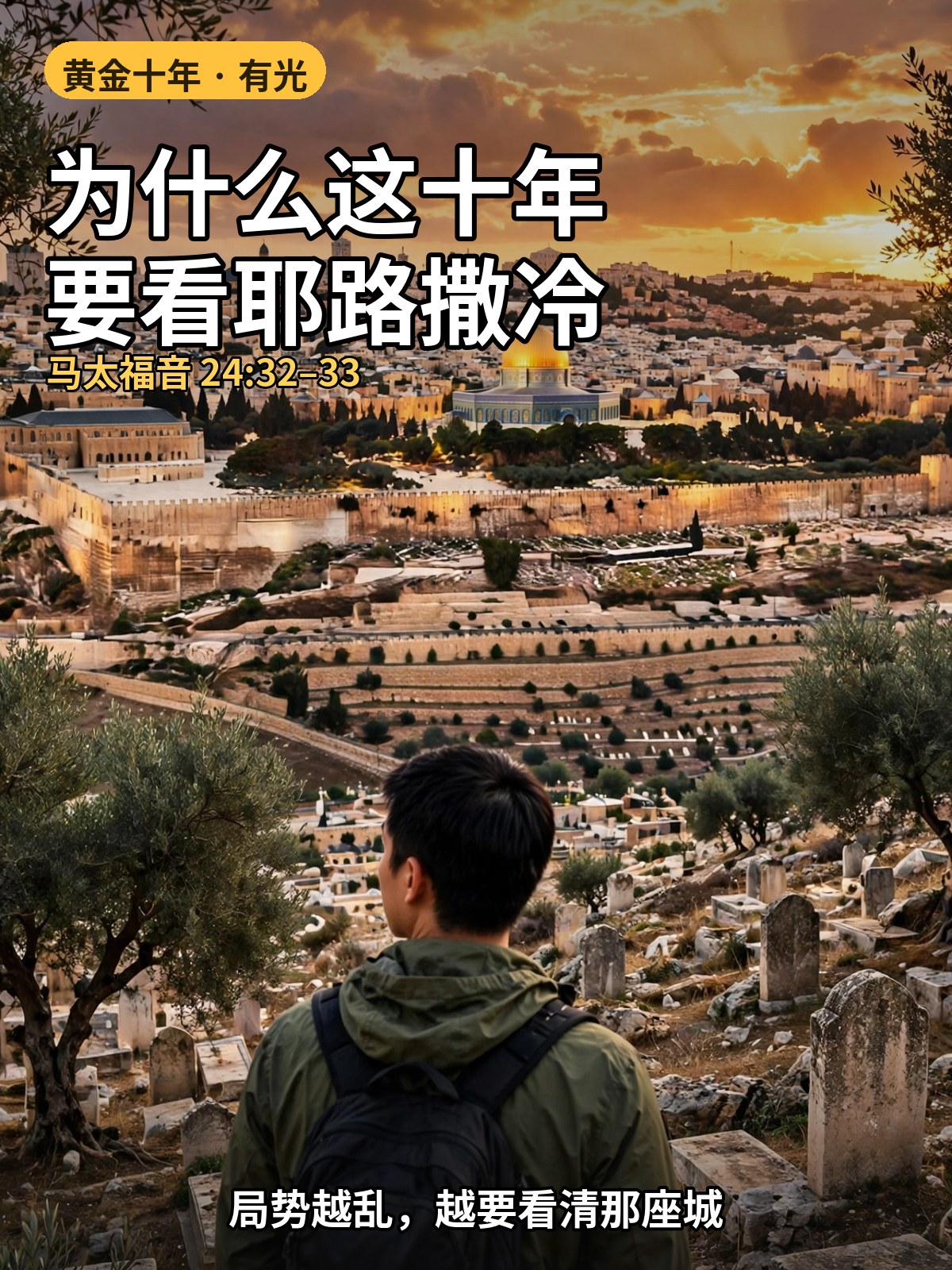
When the Fig Tree Softens and Puts Forth Leaves

But learn the parable from the fig tree: As soon as its branch has become tender and puts forth its leaves, you know that the summer is near. So also you, when you see all these things, know that He is near, at the doors. Truly I say to you that this generation shall by no means pass away until all these things happen. — Matthew 24:32–34
On the Mount of Olives, after the Lord Jesus finished speaking of the signs of the end, He did not give the disciples a timetable. He gave them a tree.
The fig tree is the most ordinary tree in Palestine. In winter its leaves all fall, leaving only bare branches; once the weather warms, the branches first soften, then put forth leaves — and the locals know at a glance: summer is near, and the fruit-harvest is not far off. With this common sense that everyone understands, the Lord teaches us a spiritual matter: signs are not for calculating dates; they are for recognizing seasons. See the leaves, and you know the season has changed; when the season has changed, people should prepare.
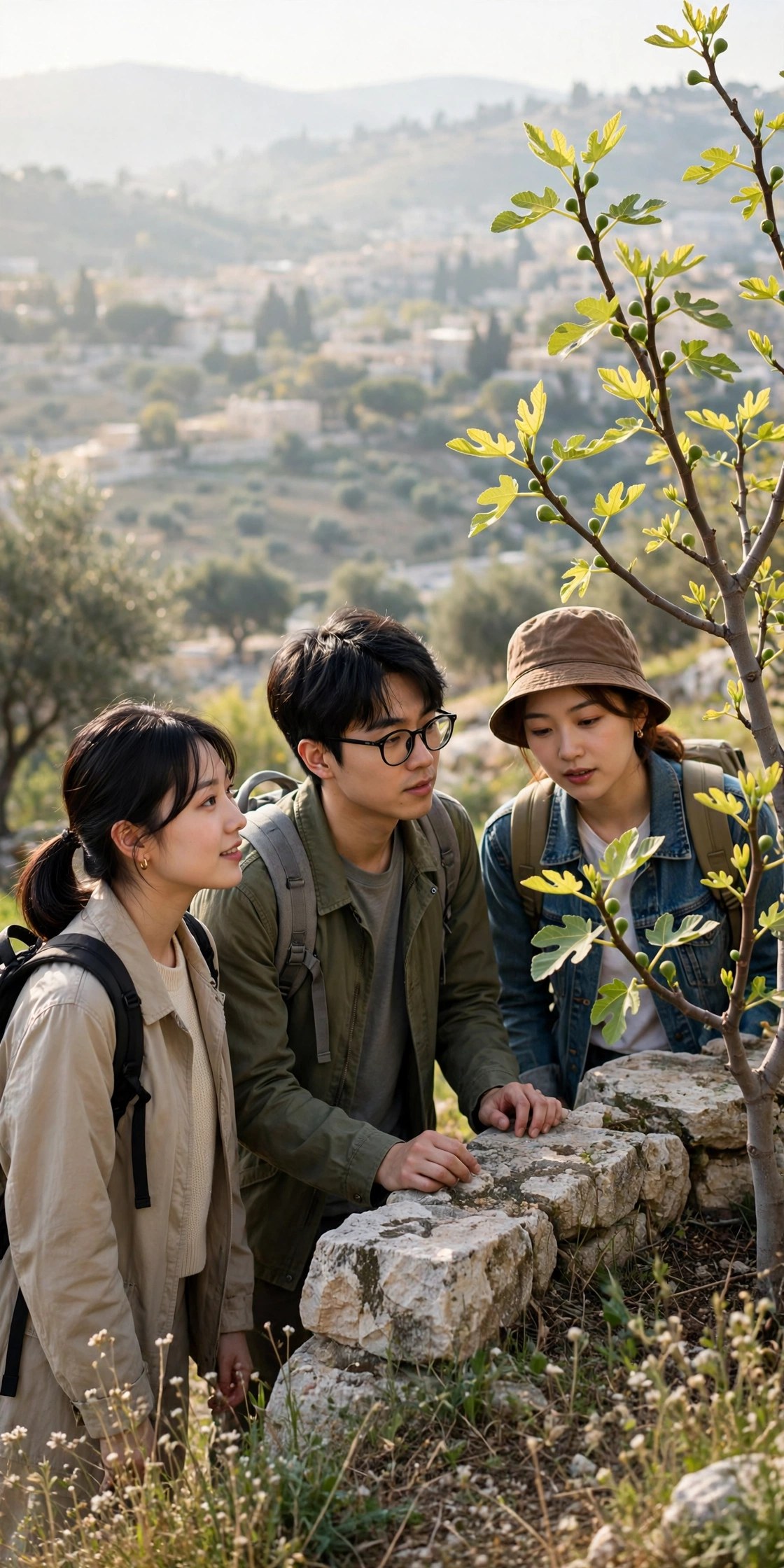
Then what does the fig tree refer to? Here we must speak clearly: the Scripture only says "learn the parable from the fig tree"; the Lord Himself did not plainly say here whom it symbolizes. There is such a view — in the Bible's usage, the fig tree is often connected with Israel: Hosea says that God found Israel "like grapes in the wilderness" and saw their fathers "like the first fruit on the fig tree in its first season" (Hos. 9:10); Joel places a destroyed fig tree within the picture of Israel under judgment (Joel 1:7); and the Lord Jesus Himself once cursed a fig tree that bore no fruit, and told a parable of a vineyard owner pleading for leniency for a fig tree (Matt. 21:19; Luke 13:6–9). So quite a few Bible readers hold that the fig tree of Matthew 24 softening and putting forth leaves prefigures Israel sprouting again after many years of withering and scattering. This is a view with a scriptural basis, but let us say it honestly: it is an interpretation, not the Lord's explicit declaration, and each person can check the Scriptures for himself.
If we read history in light of this view, it becomes very thought-provoking. Israel's kingdom fell, its people were scattered among the nations, and for nearly two thousand years it had neither its own land nor its own government — like a tree that has passed through winter, with only bare branches left. In 1948, Israel was restored as a nation. A people scattered for nearly two thousand years returning to that land, using the same language, establishing the same country — there is no second example of this in human history. We set this matter here and state only the historical fact: it happened. As for how it corresponds to the parable of the fig tree, that is a reading and receiving of the Scriptures — not news, and not a settled conclusion. But precisely because of this correspondence, many people pay special attention to the Lord's word: if the tree has truly softened and put forth leaves, summer is not far away.
Next comes the Lord's hardest sentence: "This generation shall by no means pass away until all these things happen." Which generation does "this generation" mean? There has never been only one interpretation: some take it as the generation of the Lord's own day, holding that part of the prophecy was fulfilled when Jerusalem was destroyed in A.D. 70; others take it as "the generation that sees all these signs begin" — that is, the generation of the fig tree's sprouting will not pass away before the Lord returns. We do not write either reading as a settled conclusion; we only remind ourselves of one thing: whichever way it is read, the Lord's emphasis is not on satisfying our curiosity, but on the next sentence — "Watch therefore" (Matt. 24:42). What prophecy gives us is never a date; it is an attitude.
And one more verse must be placed alongside, lest we go astray: "But concerning that day and hour, no one knows, not even the angels of the heavens nor the Son, but the Father only" (Matt. 24:36). The Lord Himself drew the line here with His own mouth. Whoever calculates that the Lord will surely return in such-and-such a year and month has crossed this line. We study prophecy in order to watch and prepare, not to announce the Father's schedule ahead of Him.
Then how should those who see the tree sprouting live today?
First, pray for the peace of Jerusalem (Psa. 122:6). That land and that people have His heart's desire in God's plan; we do not watch the excitement — we intercede.
Second, redeem the time and preach the gospel (Eph. 5:16). The season drawing near does not mean quitting business or quitting study; it means spending the remaining time more earnestly — Noah lived his ordinary days while building the ark; we work and live well while bringing the gospel to those who have not yet heard.
Third, prepare ourselves, like a bride awaiting the bridegroom. The one the Lord will marry when He returns is a prepared bride (Rev. 19:7). Preparation is not hoarding fear; it is drawing near to Him daily, being washed by His word, and letting our life become more like Him day by day.
You see, a fig tree sprouting is the most ordinary thing in spring. Yet the Lord used it to remind us: God works in His seasons, and seasons are shown to those who pay attention. May we be people who pay attention — attentive to the Scriptures, attentive to the times, and attentive to our own inward condition — quietly and joyfully waiting for Him to come.
One step for today: read Matthew 24 slowly once through, and while reading do just one thing — whenever you come to a command the Lord gives us (such as watch, be ready, be faithful), make a mark beside it. Today, do not study the signs first; live out the commands first.